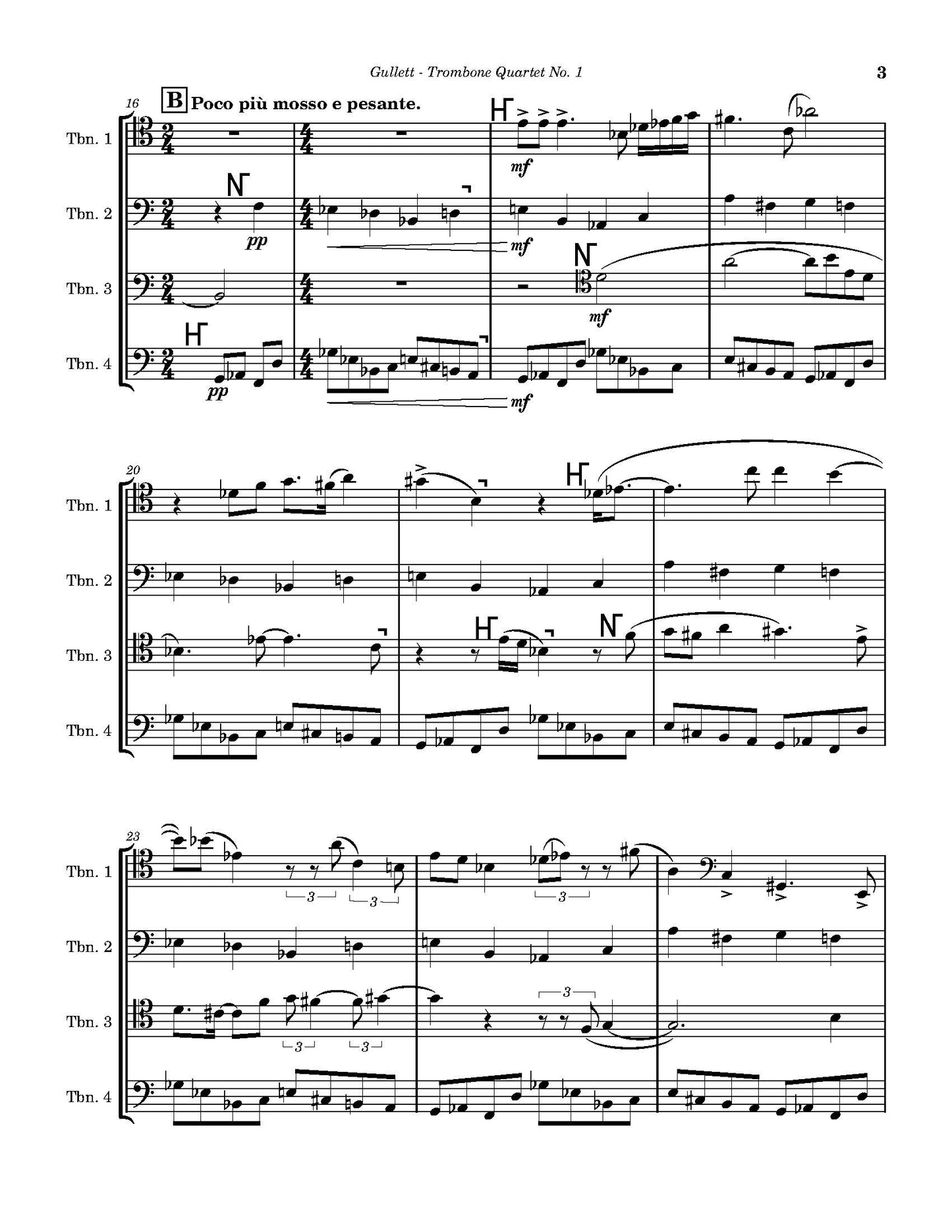
"This quartet was written during a period of strong obsession with the music of the Second Viennese School, particularly that of Alban Berg. It is divided into four movements, with each subsequent movement journeying further from serialist restrictions.
The first movement, “Prelude,” is by far the most influenced by serialist ideals. The first half has all four musicians adhering strictly to one collective tone row. As the movement progresses, however, the first and third trombonists share a tone row while the second and fourth trombonists diverge and present a heavy ostinato figure with their own unique tone rows. Its brief coda sends the fourth trombonist near the bottom of the bass trombone’s range, again with all four musicians sharing one tone row.
Although less restrictive, the second movement, “Chorale,” is still governed by serialism. The difference from the first movement, however, is that each musician follows their own distinct tone row. At the point in the movement where a recapitulation is expected, the tone rows everyone has been following are now inverted (with a few very small changes).
“Scherzo,” the third movement, is the first time when this piece noticeably strays into a freer compositional style. The primary focus of this movement is a shared string of meandering, seemingly improvisatory eighth notes that remains uninterrupted for the movement’s entire duration. What really drives the texture and intensity, however, are the varying accompaniment figures that the main line dances around. This movement features very dramatic ups and downs, all leading to a sudden, chaotic end.
Upon reaching the fourth movement, “Nocturne,” the piece is free of any deliberate, nontraditional restrictions. The opening finds itself in a very dark, obscured state where all four voices softly poke through the textural surface. Seamlessly stemming from the opening texture comes a setup that builds into a very bombastic dance. After the dance fades into the distance, darker material like the opening returns (though this time with a sense of building anxiety). Once this anxious buildup reaches its high point, however, a hopeful, calming iteration of the opening quietly takes its place. This sudden change of character leads up to a very passionate peak that quickly fades back into nothing. A rich, soft coda breaks the silence that settles on a peaceful, definitive ending, finally completing the piece’s journey from intense restriction to emotional freedom."
- Derek Gullett